Full Fibre to the Premises runs fibre all the way to your site – check availability and see our latest prices.
Full Fibre to the Premises runs fibre all the way to your site – check availability and see our latest prices.

Our Award Winning Suppliers


FTTP is a broadband service where fibre runs directly to your premises, delivering higher speeds, greater reliability and improved performance compared to older copper-based connectivity technologies.
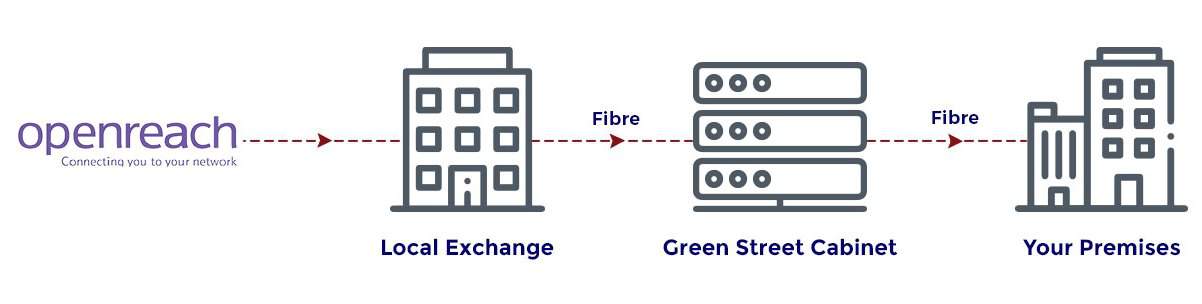
FTTP (Fibre to the Premises) is a full-fibre broadband service where fibre optic cabling runs directly from the exchange into your building. This end-to-end fibre connection delivers ultrafast speeds, higher stability and better long-term performance than copper-based options such as FTTC or ADSL.
If you’re exploring an upgrade to full fibre, this guide will help you understand what FTTP is, how it works and why it matters.
You’ll learn the key differences between full-fibre and part-fibre networks, how FTTP supports modern business connectivity and what equipment you need for Wi-Fi access. You can also check availability at your address and view our business pricing instantly.
FTTP (Fibre to the Premises) is a full-fibre broadband connection that delivers fibre directly into a business premises, offering higher speeds, lower latency and greater reliability than copper-based services such as FTTC.
FTTP provides higher speeds, improved reliability and consistent performance, supporting cloud services, VoIP, remote working and modern applications more effectively than traditional copper-based broadband solutions.

Full-fibre broadband offers tangible advantages for commercial environments where connectivity underpins everyday operations. Because FTTP provides a dedicated fibre route directly to your building, it significantly reduces latency, drops, packet loss and interference.
This means smoother video calls, faster data transfers and more consistent performance during busy periods or at peak times. Businesses increasingly rely on cloud applications, hosted phone systems, CRM platforms and remote collaboration tools. FTTP supports these without congestion, enabling staff to work efficiently from anywhere.
Its higher upload speeds also improve activities such as file sharing, remote backups and server access. Overall, FTTP gives organisations a faster, more resilient connection that helps improve productivity and future-proof their network.
See how FTTP compares with FTTC and leased lines in terms of speed, reliability, cost and suitability, helping you choose the right connectivity option for your business.
Many businesses comparing broadband options quickly discover how similar the terminology sounds — yet the performance and cost differences can be significant.
FTTC uses fibre to the street cabinet but switches to copper for the final run, which limits speeds and reliability.
FTTP removes copper entirely, delivering full fibre directly to your premises for ultrafast speeds and improved stability.
Leased lines go further by offering a private, uncontended fibre connection with guaranteed performance, ideal for organisations where uptime and symmetrical speeds are mission-critical.
| Feature | FTTP (Full Fibre) | FTTC | Leased Line |
|---|---|---|---|
| Connection type | Full fibre direct to premises | Fibre to cabinet + copper to premises | Dedicated fibre circuit to your premises |
| Bandwidth symmetry | Asymmetric (higher download than upload) | Asymmetric | Symmetrical speeds (equal up/down) |
| Download speeds | 100Mb – 1Gb+ | Up to 80Mb | 100Mb – 10Gb+ |
| Upload speeds | 20Mb – 115Mb+ | Up to 20Mb | 100Mb – 10Gb+ |
| Reliability | High | Moderate | Guaranteed SLA-backed reliability |
| Contention | Shared network | Shared network | 1:1 uncontended |
| Installation time | Fast where available | Standard | Longer (survey + build required) |
| Monthly cost | Medium | Lower | Higher (premium service) |
| Availability | Rapidly expanding | Nationwide | Available UK-wide to most commercial addresses |
| Best for | Businesses needing ultrafast broadband | Homes and small offices | Businesses needing guaranteed uptime / performance |
FTTP delivers ultrafast broadband but leased lines offer guaranteed performance — choose based on speed vs reliability needs.
Multiple UK networks now offer FTTP, but pricing and availability vary by location, so checking coverage at your address is essential before reviewing full fibre business costs.
FTTP is delivered by several major UK networks, including Openreach, CityFibre, Virgin Media, TalkTalk and Vodafone, each with different coverage footprints.
Because availability differs between suppliers, the pricing you see depends on whether your premises can currently access full fibre from one or more carriers.
Our FTTP checker lets you confirm coverage instantly and view our business broadband pricing for addresses where FTTP is live. This ensures you see accurate costs without guesswork or comparison tables that don’t apply to your area.
If FTTP is not yet available, the checker will also highlight alternative options such as SoGEA or leased lines, helping you choose the best connection for your location.
FTTP rollout is expanding across the UK, and our postcode tool lets you see instantly whether full fibre is live at your address and what speeds you can order.
Different FTTP speed tiers support varying workloads, from everyday business connectivity to high-demand cloud environments, helping you choose the right performance level for your organisation’s needs.

FTTP is available in multiple speed tiers, allowing businesses to match bandwidth to their operational needs. Entry-level packages typically deliver up to 330Mb download, ideal for smaller offices, VoIP usage, video conferencing and cloud applications.
The 550Mb tier suits organisations with heavier file transfers, multiple remote workers or hosted systems. At the top end, gigabit services support data-intensive environments, frequent backups, large media transfers and high numbers of concurrent users.
Higher upload speeds also improve collaboration tools and remote access performance. Each tier uses the same full-fibre infrastructure, meaning you can upgrade as requirements grow. Choosing the right option ensures reliable performance without overpaying for unused capacity.
FTTP availability is expanding rapidly nationwide as networks replace legacy copper, with coverage growing every month and new regions gaining access to full-fibre services.
The UK’s fibre rollout continues to accelerate, with Openreach, CityFibre and other operators investing heavily to replace ageing copper networks. As a result, FTTP coverage increases month by month, with more exchanges and postcodes moving into full-fibre zones.
While availability remains higher in urban and commercial areas, regional builds are expanding fast, giving more locations access to ultrafast broadband. However, coverage still varies between providers, which is why checking your specific address is essential.
Entering your postcode confirms whether FTTP is active and which speeds you can order. If your area is not yet live, alternative services such as SoGEA or leased lines remain available, ensuring reliable connectivity while rollout continues.
Selecting the correct FTTP package depends on your users, bandwidth demands and growth plans, ensuring you balance reliable performance with suitable capacity for your business.

Choosing the right FTTP tier begins with understanding how your organisation works. Smaller teams relying on email, browsing, VoIP and video calls often find 330Mb services more than sufficient. Businesses transferring larger files, hosting cloud platforms or running multiple high-demand applications typically benefit from the 550Mb tier.
Meanwhile, data-heavy environments or those requiring maximum responsiveness often select gigabit speeds. It’s also worth considering future growth—full fibre makes upgrading simple if requirements change.
By reviewing how many people use your network, which applications they depend on, and whether remote working or cloud services are central to operations, you can select the most appropriate FTTP package with confidence.
Choosing the right full-fibre solution isn’t just about speed. Below are in-depth guides covering pricing, availability, comparisons and real-world business use cases to help you decide.
Is FTTP right for business use?
Learn when FTTP is suitable, when it isn’t, and how it compares to other business connections.
FTTP vs FTTC: what’s the real difference?
A side-by-side comparison explaining speed, reliability, copper vs full fibre, and real-world performance.
FTTP vs leased lines: which should you choose?
Understand the difference between best-effort full fibre and dedicated, SLA-backed connectivity.
FTTP availability checker: can you get full fibre at your address?
How availability works, what “planned” really means, and how to interpret checker results.
FTTP pricing explained: what you actually pay for
A clear breakdown of monthly costs, installation fees, routers and why prices vary.
Yes. FTTP, Fibre to the Premises and Full Fibre all refer to the same technology: end-to-end fibre cabling directly to your property for high-performance connectivity.
FTTP uses fibre optic cabling from the exchange straight into your premises. This allows data to travel at extremely high speeds without the interference or signal loss seen on copper lines.
Availability varies by postcode. You can check whether FTTP is live at your address using the on-page availability checker, which instantly shows if full fibre can be ordered.
FTTP typically offers download speeds from around 100Mb to 1Gb or higher depending on the package. Upload speeds can reach over 100Mb, making FTTP ideal for cloud services and video conferencing.
No. FTTP is delivered entirely over fibre and does not require a traditional phone line. If voice services are needed, they are provided using VoIP.
FTTP is full fibre directly to your building, offering ultrafast speeds and high reliability. FTTC uses fibre only to the cabinet, switching to copper for the final stretch, which limits speed and consistency.
SoGEA removes the phone line but still uses copper for part of the connection. FTTP is full fibre end-to-end and therefore significantly faster and more reliable. Where available, FTTP is the better choice.
FTTP is suitable for most businesses, but organisations needing guaranteed uptime, symmetrical speeds or uncontended bandwidth often choose a leased line for maximum performance and reliability.
If FTTP is not yet live at your location, the checker will show alternative services such as SoGEA or leased lines, ensuring you still have access to fast and reliable connectivity.
Let us know, if you need some help and didn’t find an answer to your question.
Not only do we work with every single top tier provider in the UK, We also offer a price promise guarantee on all our quotes for all our products.
If you find a cheaper quote elsewhere, simply let us know. If it’s a “like for like” proposal, not only do we price match but we will beat it for you! Simply ask for more details.

Our Proud Customers


What makes us stand out from the crowd?
We’re a very unique company in our own right offering what the other companies simply cannot. As you can see from the below, these are just a few of the reasons we are different.


Contact
Always connected and happy to help with any of your questions.